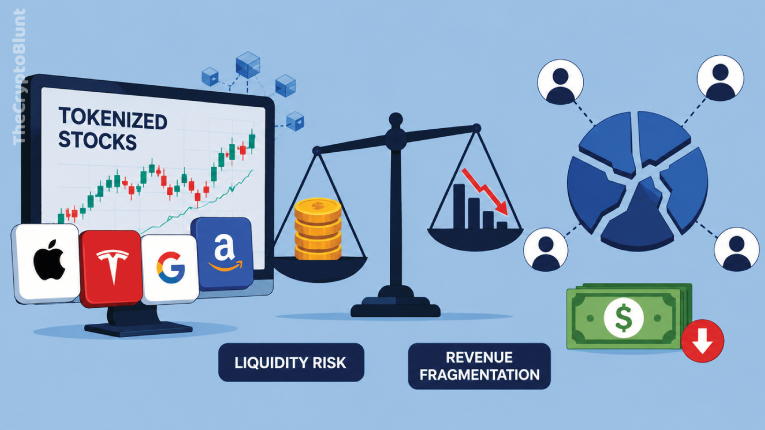
The fragmentation of what was once consolidated and centralized liquidity is viewed by TradFi as a “serious structural threat,” according to Ryan Yoon.
The move by the US Securities and Exchange Commission to allow third parties to list tokenized stocks could create two structural disruptions tied to liquidity and revenue fragmentation, according to Tiger Research.
Liquidity fragmentation could emerge as capital spreads from centralized exchanges across multiple blockchain platforms, Ryan Yoon, director and head of research at Tiger Research, said on Friday.
“Traditional finance views the breakup of its previously consolidated, centralized liquidity as a serious structural threat,” said Yoon.
When the same listed stock is tokenized by third parties across different blockchain networks and decentralized platforms, trading volume and order flow that would normally concentrate on a single venue, such as the New York Stock Exchange or Nasdaq, instead become dispersed across multiple venues, he explained.
“This creates price discrepancies across platforms, increases slippage on large orders, and ultimately degrades overall market efficiency.”
The research was released five days after the US Securities and Exchange Commission announced its “innovation exemption” on Monday, allowing tokenized stocks to be listed by third-party exchanges without requiring approval from the issuer.
Revenue Fragmentation Continues to Pose Market Risk
The second possible structural disruption involves revenue fragmentation, which directly follows the fragmentation of the broader market.
“As tokenized stocks trade across multiple platforms in disaggregated form, financial revenues that should accrue to domestic exchanges instead flow offshore, with direct implications for national financial competitiveness,” said Yoon.
Capital fragmentation is already taking shape, with real-world asset open interest on the Hyperliquid decentralized exchange reaching an all-time high of $2.6 billion this week.
Ryan Yoon concluded that this transition “poses the deepest strategic dilemma for incumbent financial institutions and regulators alike.”
Maja Vujinovic also warned that markets could become divided into “disconnected pools,” creating “dangerous price tracking errors and shadow-shorting vulnerabilities where there aren’t enough localized buyers to stabilize a specific token’s price.”
Meanwhile, Hester Peirce said on Thursday that any exemption would remain “limited in scope,” permitting only “digital representations of the same underlying equity security that an investor could purchase in the secondary market today.” A final ruling outlining what will and will not be allowed has not yet been finalized.
Markets Gain Multiple Practical Advantages
According to the Blockchain Council, tokenized stocks are argued to offer practical market advantages, including faster settlement, fractional ownership, reduced transaction costs and the possibility of around-the-clock trading.
Global accessibility allows non-US investors to gain exposure to high-demand US stocks without being restricted by limitations imposed by local brokerage platforms.
Brian Vieten said, “We believe this will accelerate the transition of the US financial system from legacy rails to onchain blockchain-based rails.”
“We expect a portion of this flow to eventually flow to high-quality blockchain networks like Bitcoin and Hyperliquid,” he added.